We Were Told There Is No Scientific Evidence for UFOs. Our Research Says Otherwise

Liberation Times Insight
Written by Beatriz Villarroel - 15 January 2026
Two months ago, the documentary The Age of Disclosure premiered in theaters and on Amazon Prime Video.
In the film, 34 government officials, including Secretary of State Marco Rubio and senior members of Congress from both parties, reveal what they are able to disclose publicly about unidentified flying objects (UFOs).
Rarely have so many highly credible testimonies been assembled in a single production, which quickly became the most-purchased film on the streaming platform.
We learn not only about UFO sightings, but also about serious allegations of secret government programs studying UFOs, crash-retrieval efforts involving non-human vehicles, and threats directed at whistleblowers.
The implications are enormous: our planet may be visited — or even inhabited — by another intelligent species, far more advanced than ourselves.
The Age of Disclosure has been met with both fascination and skepticism. The skeptics’ central response has been, “Where is the data? Where is the evidence?”
Unsurprisingly, many news outlets have opted for lighter undertones in their coverage, choosing their language carefully to distance themselves from the exotic nature of the claims made in the film.
The topic has long been ridiculed and stigmatized within scientific circles, where engaging with it was considered a near-certain path to career ruin. Media houses and editors often fear publishing pieces that might appear to support such claims, and any articles that do emerge tend to downplay their significance.
But is there truly a serious lack of evidence for UFOs, as skeptics have insisted since the 1950s?
For the past several years, my colleagues and I have analyzed “transients,” intriguing astronomical phenomena which change in brightness – or disappear entirely – over short periods of time.
Our research has zeroed in on hundreds of thousands of bright, star-like short flashes of light, recorded in photographic surveys of the night sky. Importantly, these astronomical observations are from the years before the Soviet Union launched the first man-made satellite, Sputnik, in 1957.
In two papers published recently in respected, peer-reviewed scientific journals, we make a compelling case that at least some of these bright flashes are reflections of the Sun off of objects of unknown, but non-natural, origin.
We also find a statistically significant correlation among these bright flashes, historical eyewitness UFO reports, and above ground nuclear tests that were being conducted at that time. Unsurprisingly, our work has garnered significant attention from our scientific colleagues.
At the core of our findings is a mathematically striking lack of flashes observed in the Earth’s shadow, also known as the umbra, compared to those observed in the rest of the sky. This is robust evidence that many of these brief, star-like flashes are caused by solar reflections off of objects with flat, mirror-like surfaces.
Importantly, the deficit of flashes in the Earth’s shadow also indicates that these transients are not optical defects, dust, or other imaging artifacts. Such artifacts, after all, have no reason to avoid the Earth’s shadow.
Even our most conservative statistical analysis of the data finds that, when compared to the rest of the night sky, the lack of flashes in the Earth’s shadow is remarkably robust, measured at 7.6 sigma.
To illustrate just how strong our core finding is, many peer-reviewed journals publish astronomical discoveries at the ~2–3 sigma level (events corresponding to only a ~5 – 0.3% probability of occurring by chance).
In particle physics, the threshold for a discovery is much more stringent, set at 5 sigma (chance probability ~0.00006%). Our findings correspond to a probability of the observed deficit of flashes in the Earth’s shadow occurring purely by chance of about 10⁻15, which is infinitesimally small (i.e., a decimal point followed by 15 zeroes).
Importantly, the optical properties of the telescope and photographic plates that we analyzed are such that these fleeting solar flashes must have originated at altitudes of at least several hundred kilometers.
Any observations from objects at lower altitudes, such as brief reflections or flashing lights from balloons or airplanes, or other phenomena such as solar flare or ionizing radiation, would appear severely defocused (and diluted during the 50-minute exposure), and are easily identifiable.
Nor can these flashes be explained by asteroids, ice grains or other natural phenomena. These prosaic phenomena typically appear as round, rough, and leave streaks on the long, 50-minute exposures of the photographic plates that we analyzed.
In short, our observations indicate the presence of objects with flat, highly reflective (mirror-like!) surfaces in orbit years before the first man-made satellites.
We also found several instances where bright flashes appear in a line or a narrow band. After applying rigorous statistical methods, we found that the probability of several of these alignments (or formations) occurring purely by chance is so implausible that it can be confidently ruled out.
The most statistically significant alignment of transient flashes in our dataset occurred on July 27, 1952, a date which stands out in UFO lore. Over the course of two successive weekends in July 1952, pilots, air traffic controllers, and radar operators at three stations in the Washington, D.C., area observed objects conducting seemingly extraordinary maneuvers.
One must wonder whether our most statistically robust alignment of bright, orbital flashes coinciding with the last day of the 1952 Washington, D.C., incidents is pure coincidence.
The correlation between bright, transient flashes and eyewitness UFO reports does not end with the July 1952 incidents.
We found a statistically significant link among orbital flashes, a catalog of historical eyewitness UFO reports, and above-ground nuclear tests.
As it turns out, bright, astronomical flashes were 68% more likely to occur on the day after a nuclear test than on days without testing, and their number increased by an average of 8.5% for each reported UFO sighting on the same date. When both nuclear tests and UFO reports coincided, the effects combined, producing more than twice as many flashes as on control days.
Given a well-documented history of UFO observations around nuclear facilities and sites, these three-way correlations are intriguing. They are also a further refutation of the common, yet unfortunate, critique that all transients are merely photographic or optical defects.
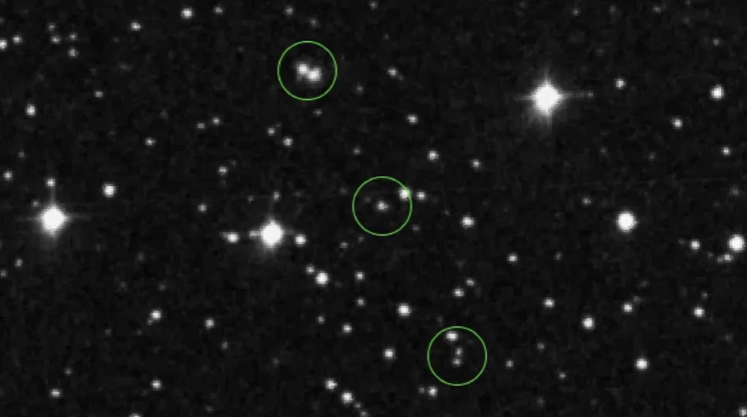
Above: Transients we studied from 27 July 1952, the same night as the famous Washington D.C. UFO flap
That critique continues to circulate, despite being ruled out by our findings. Several science media outlets, including Scientific American, have published other scientists’ initial responses to our work. While we welcome all constructive criticism from our scientific colleagues, no critique to date has been able to account for the full pattern of our results.
Moreover, our findings are particularly intriguing when viewed in historical context. The September 1947 “Twining Memo,” in which Air Force general and future Joint Chiefs of Staff chair Nathan Twining recommended that the Air Force formally study UFOs, characterized the phenomena as “real and not visionary or fictitious.”
The document summarizes UFOs primarily as disk-like objects with a “metallic or light reflecting surface,” “elliptical in shape” and “flat on [the] bottom.” While our current survey makes it hard to say anything about the geometry and movement of the objects, such mirror-like characteristics are precisely what is required to create the bright flashes that we observe in our pre-Sputnik astronomical surveys, which span 1949 to 1957.
Similarly, the earliest surviving Air Force assessment of UFOs, dating to December 1948, makes frequent reference to credible observations of “metallic disks” “with a flat bottom.”
This includes reports of such objects several months prior to Kenneth Arnold’s June 1947 encounter with nine disks that, in line with our findings, glinted brightly in the sunlight.
As the Air Force analysis notes, such pre-Arnold sightings eliminate media coverage as influencing observations of strange, disk-like metallic objects. Other government documents, dating well into the 1960s, also describe credible reports of such objects
Do our findings corroborate contemporaneous eyewitness reports of UFOs? Did metallic, disk-like objects reflect sunlight high above Earth before the first man-made satellites? Is there a link between UFOs and our nuclear technology?
Our findings are difficult to dismiss out of hand. They certainly give credence to the extraordinary allegations presented in The Age of Disclosure.
In short, testimonies from government officials, members of Congress, private observations from millions of people around the globe, and newly published science all point in the same direction — that UFOs are real, and moreover, that we are not alone.
What we now hope for is that our fellow scientists will engage in robust, good-faith debate and replication efforts free of ridicule and stigma. If (or dare I say when?) these results withstand independent replication, humanity has a fascinating future ahead.
Acknowledgement: I sincerely wish to thank Marik von Rennenkampf for his kind and constructive feedback when writing this essay.
Dr. Beatriz Villarroel is a researcher in astronomy at the Nordic Institute for Theoretical Physics (Nordita) in Stockholm. She leads the Vanishing & Appearing Sources during a Century of Observations (VASCO) project (www.vascoproject.org) and the EXOPROBE project. The VASCO project searches for vanishing stars with the help of automated methods as well as a citizen science project.