The Pentagon’s UFO Office Knows They’re Real. But Can It Tell the Truth?
Written by Christopher Sharp - 4 May 2026
The official line: there are true anomalies which the head of the Pentagon’s UFO office does not understand with his physics and engineering background, and from his time in the Intelligence Community.
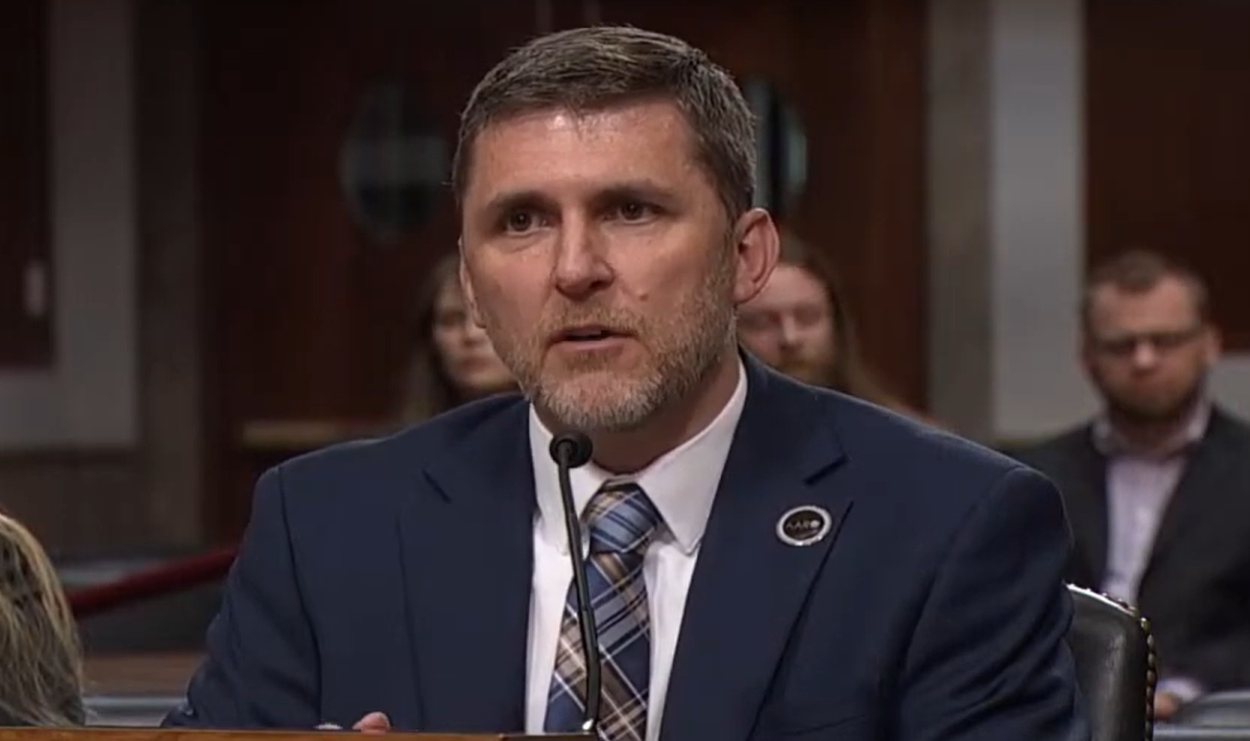
Dr. Jon Kosloski, director of the All-domain Anomaly Resolution Office, or AARO, has since described Unidentified Anomalous Phenomena, or UAP, as “really peculiar” and “perplexing”.
His predecessor at AARO, Tim Phillips, has told Liberation Times that the office has encountered cases in which UAP appear to display capabilities not seen in any known aircraft or spacecraft.
Although Phillips did not state that such objects reflected non-human or alien activity, he said there were incidents by “highly qualified observers that they saw some truly astonishing performance capabilities - things that no known human system could behave.”
Phillips said the incidents could not be attributed to any known U.S. or adversary technology, or in his own words: “We were able to conclusively prove it wasn't a known system, either adversary or friendly.”
The existence of these extraordinary phenomena is no longer really in doubt. UFOs are real.
The real question now is where they come from and what intentions they have.
As the White House now prepares to disclose never-before-seen UAP information to the public, the question of origin and intention will now loom over everything else
But while searching for the best evidence and information, the White House may well have to look beyond AARO to support this next vital step.
The AARO is still a Pentagon office.
It’s nested within the same national security system that whistleblowers say has long controlled and buried the issue.
Many whistleblowers do not trust AARO.
That distrust was sharpened by the fact that the office grew out of the Airborne Object Identification and Management Synchronization Group or AOIMSG.
AOIMSG was located within the Office of the Under Secretary of War for Intelligence and Security (OUSDI&S), whose formal responsibilities include intelligence, counterintelligence, security and insider-threat policy.
This certainly puts into question whether AARO’s witness outreach was truly well-intentioned, as opposed to a counterintelligence and insider threat exercise.
Official Department of War (DoW) directives show that OUSDI&S helps set and oversee security policy for Special Access Programs, provides security oversight for components managing Special Access Program-related equities, and monitors counterintelligence issues, security violations and infractions involving those programs.
A Special Access Program (SAP) security manual from 2025 states that OUSDI&S - which also has oversight for the National Reconnaissance Office and National Geospatial-Intelligence Agency, ‘Establishes, develops, and coordinates DoD SAP security policy and provides security oversight…’
To whistleblowers, that matters enormously.
They were being asked to place sensitive UAP information into a system built not only to investigate, but to protect, contain and police access to classified secrets.
Although AARO is now situated within the Office of the Secretary of War, its original architecture was built by OUSDI&S, which also appointed its former Director, Dr. Sean Kirkpatrick.
Note, Kirkpatrick was selected by David Taylor, Under Secretary of War for Intelligence & Security, a figure sources have told Liberation Times has long been hostile to UAP.
Congress has already pushed for an outside review of AARO.
Its credibility has been damaged by attacks on whistleblowers, a disputed Congressionally mandated historical report and questions over how key cases were handled.
Tim Phillips told Liberation Times that AARO did not have the power to decide, by itself, that whistleblower material should be classified.
But it could still mark material as classified by relying on existing rules used by agencies such as the DoW, the Office of the Director of National Intelligence and the CIA.
Phillips stated:
“AARO were not a cabinet-level office. We don't have the authority to classify. We have to go by classification guides - derivative classifiers. So they would use the classification guides, say for the Department of Defence or the Director of National Intelligence or CIA. But that's how we classify - it's called derivative classification. And he's correct.
“Someone would come in, and we'd look at it. If we thought it was going to compromise sensitive government capabilities secrets, there are methods and ways to protect that and classify it accordingly."
This appears to have happened in the case of Dylan Borland, a former U.S. Air Force geospatial intelligence specialist and UAP whistleblower who has testified before Congress.
Borland provided AARO with three drawings. Two of them were later treated as classified under existing classification guides. When asked about this by Liberation Times, Phillips did not dismiss that account.
In its 2024 annual report, AARO publicly stated that it had no data indicating the capture or exploitation of UAP.
But that position has to be read alongside the office’s classification system.
In other words, if evidence of UAP capture or exploitation were controlled by another agency or protected under an existing classification guide, AARO may not be able to acknowledge it publicly.
Also, its position must account for the national security world, where denial, concealment, cover and authorised deception can be legitimate protective tools.
The paradox is that AARO has helped move the official position forward, while also embodying the very system many whistleblowers distrust. It has acknowledged unresolved, highly anomalous cases.
But it was created inside an intelligence and security architecture built for threat assessment, attribution and the protection of sensitive information.
That does not mean AARO is acting in bad faith.
But it does mean the office may be structurally ill-suited to deliver the kind of disclosure now being demanded. Its role is not simply to reveal.
It is also to protect.
And yet, even while managing disclosure, AARO has still helped confirm something remarkable: some UAP seem to exhibit capabilities beyond any known human system.
No official has asserted UAP to be of ‘non-human origin’.
But the range of other explanations is shrinking.
As President Trump considers declassifying information and possibly even physical materials, he should look closely at the Senate Select Committee on Intelligence.
Liberation Times understands that, in 2022, the Committee was presented with verifiable information relating to secretive UAP retrieval and exploitation missions and programs.
Many of the whistleblowers who engaged with the committee have never spoken with the AARO.
Trump may now be particularly well placed to pursue disclosure, with Marco Rubio, the Committee’s former Acting Chair and Vice Chair, serving as his National Security Advisor.
Asked how far disclosure could go, two sources told Liberation Times that the existence of recovered exotic vehicles may be acknowledged, including that the United States has possession of them.
That decision, if taken, would be based on an understanding that other nations possess similar vehicles.
The aim, sources said, would be to increase the resources dedicated to reverse-engineering the technology, amid what is alleged to be an exploitation race with adversary nations.
However, the sources said any technology derived from such vehicles is unlikely to be disclosed, as doing so could breach national security.
But even if such a disclosure does occur, it may not go far enough for some.
That includes those who allege secret agreements between the United States government and non-human groups, as well as those seeking accountability for any crimes allegedly committed by those who kept such programs hidden.
So the vital question remains in play.
A disclosure that confirms recovered exotic vehicles would be historic.
But unless it addresses origin, purpose and possible intent, it would still leave the central mystery unresolved.
The public may be told that the United States has recovered objects it cannot fully explain. It may even be said that other nations possess similar material.
But without further disclosure about where such objects came from, what analysis has shown, and whether they appear to represent technology controlled by an intelligence, the globe would be left with confirmation with zero context.
That may be deliberate.
The government may decide that the technology, its exploitation and any deeper assessment of origin remain too sensitive to release. Other potential truths may be too disturbing to disclose.
But if that happens, the next battle over UAP disclosure will not be about whether extraordinary objects exist.
It will be about whether the public is allowed to understand what they mean.