Sources Blame Senator McConnell for UFO Transparency Law Failure
Written by Christopher Sharp - 3 January 2026
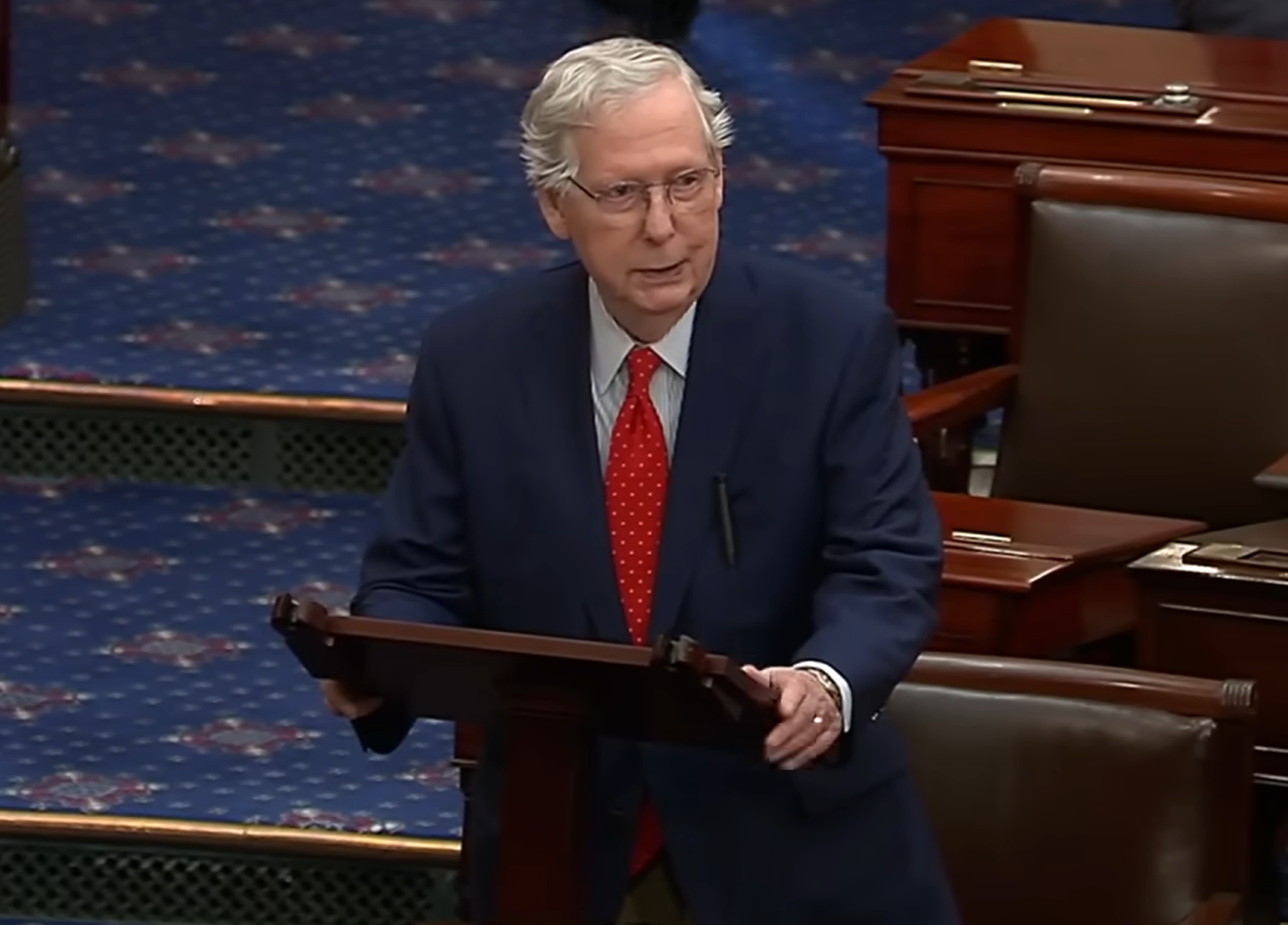
In 2025, Senator Mitch McConnell and his staff played a central role in the derailment of major Unidentified Anomalous Phenomena (UAP) transparency legislation, according to sources who spoke to Liberation Times.
Sources identify Terry Carmack, McConnell’s chief of staff, as the staffer who they say pressed to have the UAP Disclosure Act (UAPDA) stripped from the FY2026 National Defense Authorization Act (NDAA), after Representative Eric Burlison had submitted it as an amendment.
One source claimed to Liberation Times, “Mitch has always worked against it [UAP disclosure] - he is the number one villain - number two is Terry.”
During a UAP hearing on 9 September 2025, convened by the House Oversight Committee’s Task Force on the Declassification of Federal Secrets, Burlison said he had only recently learned that his UAPDA amendment had not made it into the House NDAA package.
He suggested the decision was made on ‘germaneness’ grounds—House procedure for whether an amendment is considered relevant to the underlying bill—and he added in frustration:
"Just last night, I tried to get an amendment onto the National Defense Authorization Act that fit in the germaneness [meaning relevant to a subject under consideration] of that bill to have UAP disclosure, and conveniently it was named non-germane, mostly deemed by staff, not even an elected official - this is the kind of stuff we repeatedly see."
In a recent appearance on the Psicoactivo Podcast, Burlison said there was a final, narrow window to add the UAPDA during ‘conference’—the closed-door phase when House and Senate negotiators reconcile their competing NDAA versions into a single compromise bill.
He said that, based on what he had been told by sources within the Senate, staff on the Senate Appropriations Committee were responsible for the UAPDA’s failure at that stage. However, he emphasised that the claim was second-hand—relayed to him by individuals connected to the Senate—and that he had not been able to substantiate it.
Liberation Times understands from multiple sources that McConnell—who sits on the Senate Appropriations Committee—and his office objected to the UAPDA on jurisdictional grounds, at least officially.
According to sources familiar with the discussions, the concern was that the legislation would draw the Senate Homeland Security and Governmental Affairs Committee and the House Committee on Oversight and Government Reform into some of the government’s most sensitive classified work.
Burlison’s amendment text would have provided that the chairs, ranking members, and designated staff of both committees be granted the same security clearances and access to relevant presidential and departmental or agency special access and compartmented access programs.
Put simply, that would amount to formal permission to see specific classified programs, not merely to hold a high-level clearance.
In that context, Special Access Programs and compartmented programs are ‘extra-locked’ efforts, where information is tightly restricted through additional access controls and shared only with approved individuals who have a demonstrable need-to-know.
Sources suggest the sticking point was the prospect that committee access could cut across both Title 10 authorities, which govern military operations, and Title 50 authorities, which govern intelligence activities.
First unveiled publicly in July 2023 by then–Senate Majority Leader Chuck Schumer, the UAP Disclosure Act proposed establishing an independent UAP Records Review Board to oversee the review and release of government records related to UAP.
The Board would have consisted of nine U.S. citizens nominated by the President. It would have been empowered to obtain relevant UAP records, evaluate whether they should be disclosed immediately or postponed, and advise on the terms of any release.
The proposal also included text regarding the public disclosure of certain UAP-related materials, including any potential biological evidence and associated craft, where applicable.
Under the plan, any materials or biological evidence of unknown or non-human origin would be subject to the federal government’s power of eminent domain—meaning any private entity in possession would be required to surrender them to the government.
Despite repeated efforts by Schumer and other senior lawmakers, including Senators Rounds and Gillibrand, the Act has still not been implemented in full.
Sources told Liberation Times that, in 2023, then–Senate Minority Leader McConnell was among the politicians blamed for stripping out some of the UAPDA’s most consequential provisions from that year’s NDAA.
Watergate and Pentagon Papers attorney Daniel Sheehan echoed those claims, asserting that opposition came from five influential Republicans: Senators Roger Wicker and Mitch McConnell, and Representatives Mike Turner, Mike Rogers, and Mike Johnson. In 2023, he told Liberation Times:
"98% of everybody in Congress is in support of this bill. It’s just these five guys holding it up."
In 2024, a fuller version of the UAPDA was submitted again. Once more, McConnell was blamed for the failure.
At the time, Matthew Ford—then affiliated with the UAP Disclosure Foundation—wrote on X that McConnell had blocked the UAPDA’s inclusion in the NDAA manager’s package.
In 2025, Senators Schumer, Rounds, and Gillibrand again introduced the UAPDA as an amendment, but it was not included in the Senate’s version of the NDAA.
That omission prompted Burlison to submit the measure as an amendment to the House version of the NDAA, which ultimately failed.
Liberation Times requested comment from Senator McConnell’s office and from Terry Carmack directly regarding these allegations, but had received no response at the time of publication.