An Invisible Atlantic Boundary Where UFO Reporting Changes
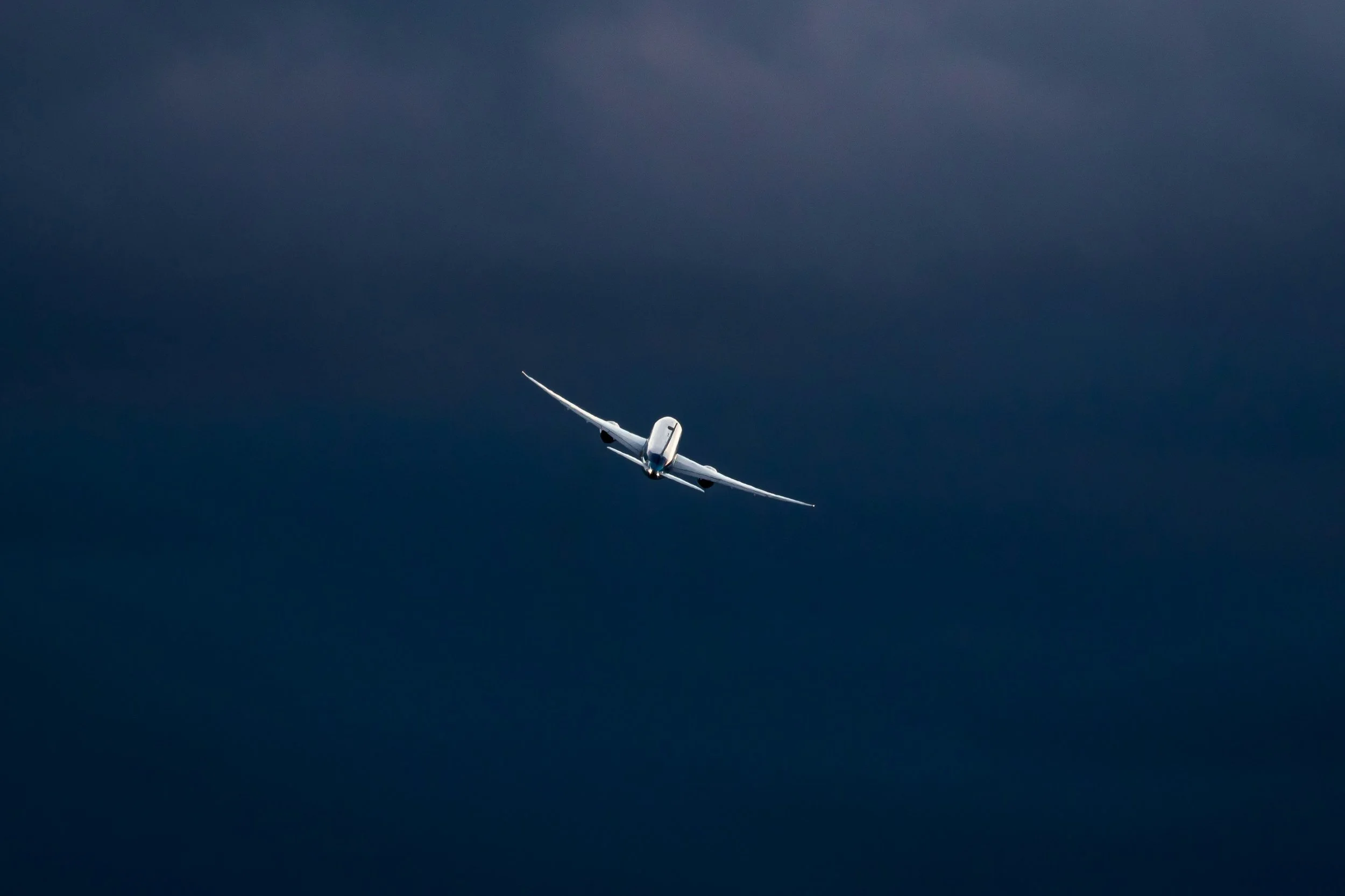
Photo by Bing Hui Yau on Unsplash
Liberation Times Opinion & Insight
Written by Chris Gaffney - 13 March 2026
A passenger jet crossing the North Atlantic can move from one system for handling reports of unidentified objects to another without anything on board changing at all.
The aircraft does not change. The crew does not change. The passengers do not change. But once a flight crosses the oceanic handover point near 30 degrees west longitude, the way Unidentified Anomalous Phenomena (UAP) and possible near misses are recorded and escalated can become far less clear.
UAP are not just a subject of public fascination. In some cases, pilots report objects they cannot identify in circumstances that raise genuine flight-safety concerns, including the risk of a near miss.
Around 2,000 aircraft cross the North Atlantic each day, making it one of the busiest aviation corridors in the world.
Roughly 75 to 80 per cent of those flights operate within the Shanwick Oceanic Control Area managed by the Irish Aviation Authority and the UK’s air traffic control service. In practical terms, that means roughly 1,400 to 1,600 aircraft per day operate within Irish-managed oceanic airspace.
Much of this route lies beyond conventional radar coverage. Instead, controllers rely on position reports, digital tracking and direct text-based communications with pilots to keep aircraft safely separated.
Yet within this vast and heavily used corridor, there is a little-known gap in how reports of UAP and possible near misses are handled.
As aircraft cross the Atlantic, they pass an operational handover point near 30 degrees west longitude, where responsibility shifts between North American and European-controlled airspace.
On the western side of that boundary, in United States-managed airspace, controllers are required to record and pass on reports of unusual aerial observations through formal channels.
Once those same aircraft cross into European-managed airspace, the position becomes far less clear.
But the differing reporting expectations can pose a big problem.
This is not a theoretical issue. Aviation safety bodies already record near misses involving objects that crews cannot immediately identify.
In Britain, official Airprox investigations in 2025 included one case in which an Airbus A320 crew reported an unidentified black object passing 50 to 100 feet below the aircraft near Newport, and another in which investigators said there had been a definite risk of collision after a large drone passed at extremely close range near an A320 inbound to Heathrow Airport.
In a separate case, a Boeing 787 crew reported a large drone passing in very close proximity at the same level while holding for approach to Heathrow, with the official assessment again concluding that a definite risk of collision had existed.
One officially acknowledged U.S. case involved a commercial flight crew reporting a near miss with a cylindrical object over the Atlantic Ocean off the coast of New York.
These examples do not all come from the same patch of airspace, but together they show why clear handling of UAP reports matters wherever collision risk may arise.
Whatever those objects ultimately were, the safety case for clear and consistent reporting pathways is obvious.
This is not really a debate about belief. It is an aviation governance issue. In one of the busiest air corridors on Earth, the process for reporting unusual aerial observations can change depending on which side of an invisible mid-Atlantic line an aircraft happens to be flying.
That question has now started to surface in Irish politics. Members of the Irish parliament from several parties have raised it.
The parliamentary committee on defence and national security has also noted it.
The timing matters.
Ireland is debating legislation that would remove the long-standing passenger cap at Dublin Airport.
More passengers will mean more flights. More flights will mean denser traffic through already busy airspace. Before that volume rises further, it is reasonable to ask whether the reporting and investigative pathways for unusual aerial observations should be clarified.
This is not just an Irish issue. The North Atlantic corridor is the main aviation bridge between the United States and Europe.
It carries huge volumes of tourism, business travel and cargo. It also matters economically. The United States is Ireland’s largest source of foreign direct investment, and millions of American passengers pass through Irish-managed airspace each year.
Christopher Mellon, a former senior United States defence intelligence official, has said it would be “a great boon to airspace and national security if Ireland would join the United States in the mandatory reporting of anomalous aerial observations.”
Readers may or may not agree with that exact prescription. But the underlying principle is hard to dismiss.
Clearer reporting strengthens aviation safety. It gives pilots, controllers and authorities a more consistent way to record, assess and learn from unusual observations in busy airspace.
Ireland will also soon hold the Presidency of the Council of the European Union. That allows it to encourage wider discussion about aviation coordination and regulatory consistency across Europe. A transatlantic corridor used by thousands of aircraft every day would seem an obvious place to begin.
The issue, in the end, is simple: aircraft crossing the Atlantic do not change.
But the reporting framework for unusual aerial observations can change before the journey is over.
In a corridor carrying thousands of flights a day, that is a question worth examining.